
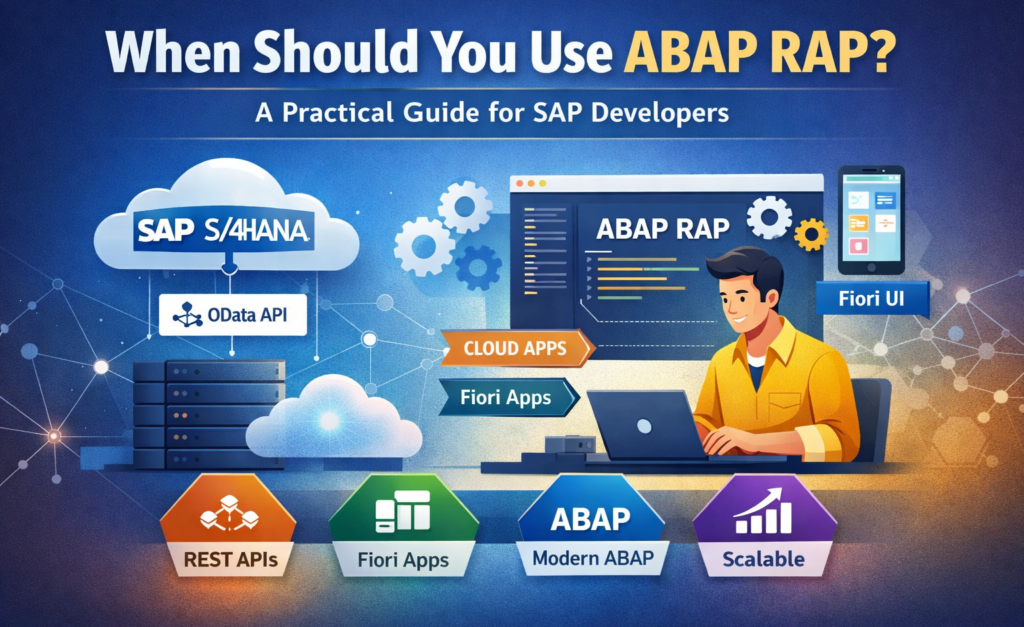
In today’s evolving SAP landscape, developers are increasingly moving toward modern frameworks that support cloud, scalability, and clean architecture. One such framework is the ABAP RESTful Application Programming Model (RAP)—a key component of next-generation SAP development.
But the real question many developers ask is: When should you actually use ABAP RAP?
This guide breaks it down in a practical, real-world way.
What Is ABAP RAP?
ABAP RAP (RESTful Application Programming Model) is a modern development framework provided by SAP that enables developers to build cloud-ready, scalable, and REST-based applications.
It is primarily used in environments like SAP S/4HANA and SAP BTP (Business Technology Platform).
Why ABAP RAP Matters in 2026
Traditional ABAP programming is still widely used, but RAP introduces:
- Clean and modular architecture
- Built-in support for OData services
- Better integration with SAP Fiori apps
- Cloud-first development approach
This makes RAP essential for businesses moving toward intelligent, API-driven systems.
When Should You Use ABAP RAP?
Here are the most practical scenarios where RAP is the right choice:
1. When Building New SAP Applications (Greenfield Projects)
If you’re starting a new development project, RAP should be your default choice.
Why?
- It follows modern design principles
- Reduces technical debt
- Ensures future compatibility
Best for: New modules, extensions, or standalone apps
2. When Developing SAP Fiori Applications
RAP works seamlessly with SAP Fiori, making UI development much easier.
Benefits:
- Automatic OData service generation
- Faster UI integration
- Consistent user experience
Ideal for: Fiori-based enterprise applications
3. When You Need RESTful APIs
If your application needs to interact with external systems or services, RAP is designed for that.
Use RAP when:
- You need API-first architecture
- You’re integrating with third-party tools
- You want reusable services
4. When Working in SAP S/4HANA Cloud
RAP is the recommended (and often mandatory) approach in cloud environments.
Why?
- Supports cloud-native development
- Aligns with SAP’s future roadmap
- Ensures upgrade compatibility
5. When You Want Faster Development with Less Code
RAP reduces boilerplate coding through built-in features like:
- Managed scenarios
- Behavior definitions
- Automatic CRUD operations
Result: Faster development cycles and fewer errors
6. When Data Consistency and Business Logic Are Critical
RAP enforces strong data integrity through its layered architecture.
Key advantages:
- Centralized business logic
- Transactional consistency
- Built-in validations
When NOT to Use ABAP RAP
RAP is powerful, but not always the best fit.
Avoid RAP when:
- You are maintaining legacy systems (ECC)
- The project requires quick minor fixes
- The team lacks RAP expertise
In such cases, traditional ABAP may be more practical.
ABAP RAP vs Traditional ABAP
| Feature | ABAP RAP | Traditional ABAP |
|---|---|---|
| Architecture | Modern, RESTful | Procedural |
| Cloud Support | Yes | Limited |
| UI Integration | Seamless (Fiori) | Manual |
| Scalability | High | Moderate |
| Learning Curve | Moderate | Low |
Benefits of Using ABAP RAP
- Future-ready development approach
- Faster application delivery
- Improved maintainability
- Better integration with modern SAP tools
- Enhanced user experience
Real-World Example
A manufacturing company implementing SAP S/4HANA wanted a custom app for tracking production orders.
Using RAP:
- APIs were created automatically
- Fiori UI was integrated seamlessly
- Development time was reduced by ~40%
Frequently Asked Questions (AEO Optimized)
What is ABAP RAP used for?
ABAP RAP is used to build modern, cloud-ready SAP applications with RESTful APIs and Fiori integration.
Is ABAP RAP mandatory for SAP S/4HANA?
It is highly recommended, especially for cloud environments, and aligns with SAP’s future development strategy.
Is ABAP RAP difficult to learn?
It has a learning curve, but developers familiar with ABAP can adapt quickly with practice.
Can RAP replace traditional ABAP?
Not completely. Traditional ABAP is still used for legacy systems, but RAP is the future for new developments.
Key Takeaways
- ABAP RAP is best for new, cloud-ready, and API-driven applications
- It simplifies development while improving scalability and performance
- It aligns with SAP’s long-term roadmap
Conclusion
ABAP RAP is not just another framework—it represents a shift toward modern SAP development.
If you’re building new applications or working in SAP S/4HANA environments, adopting RAP will help you stay ahead in the evolving SAP ecosystem.